


There´s no debate: This is the year of AI.
The progress in AI models seems limitless. Their capabilities impress, their responses amaze and the feeling that everything is about to change no longer sounds like a prediction. There´s a sensation that we´re in countdown mode. We are witnessing a major technological leap. But we have to understand one thing: “The real bottleneck in this new phase is not the models. It´s in the data”.
Why is the real AI bottleneck not the technology, but the data?
In business conversations about artificial intelligence, people talk about agents, assistants, copilots, notebooks, deterministic models, prompts, skills, connectors, repositories and orchestration.
The focus is almost always on the visible technology. On what appears in the demo. On what impresses in a meeting.
And yet there is one critical piece in this puzzle that is too often taken for granted: The Data.
We take for granted that:
- A company already has data.
- The data is available.
- That AI will understand it, organize it, connect it and turn it into decisions.
It just doesn´t work that way. It´s not that simple.
What happens when AI does not have enough context?
AI is an incredible tool, but it is not clairvoyant.
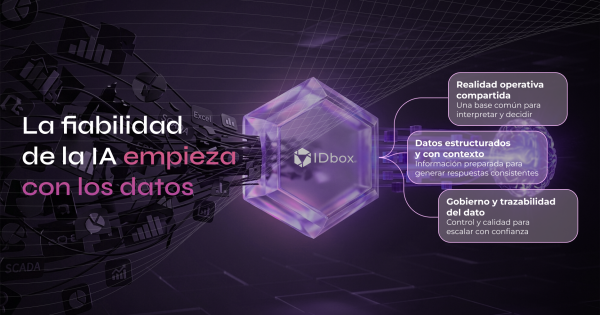
When it cannot find a solid contextual foundation, it interprets, approximates and fills in the gaps. That is exactly where we run into trouble; the same question, slightly different nuances, different answers. Not because the model is “failing” but because the organization is not always providing it with a structured, governed and coherent version of reality to operate on.
Why does fragmented data make AI unpredictable?
AI does not, by itself, fix years of technological fragmentation, inconsistent naming conventions, silos between OT and IT, signals without context, poorly governed time series, or systems that were never designed to share a common operational truth.
When data arrives fragmented, unstructured, without semantics or without traceability, AI does not become more intelligent. It becomes more unpredictable.
Will AI be the differentiating factor for companies?
Companies will not differentiate themselves by simply using AI.
They will differentiate themselves by:
- How well their data has been prepared.
- The level of governance they have in place.
- And whether they can rely on a trustworthy operational context.
Data becomes strategic infrastructure. A company’s only source of truth.
Is experimenting with AI the same as industrializing it?
No.
Anyone can experiment, it´s relatively easy.
You build a use case, connect an assistant, create a user-friendly interface and you´ve generated enthusiasm.
But it´s not that simple. Industrializing AI requires discipline; reliable, structured, normalized, governed data that is available in real time so that different systems, processes and agents can use it without any ambiguity. It requires context. It requires an operating model. It requires discipline. And it requires a suitable architecture capable of turning scattered signals into usable intelligence.
Can data governance determine a company’s growth?
It is precisely at this point which many companies will begin to split into two groups. And you don´t need a crystal ball to predict the future.
One part of the organization will continue accumulating data the way they would pile up boxes in a warehouse: lots of stuff, but poorly labeled, etc…
Companies with information spread across SCADAs, MES, historians, ERPs, spreadsheets, isolated platforms and applications that do not share a common language or context. These companies do have data, but not a reliable foundation for automating decisions.
Then there are those companies that understand that data is no longer a byproduct of operations. It is strategic infrastructure. These companies will recognize that if they want AI to truly help them operate, anticipate and decide more efficiently, they must first build a reliable source of operational reality.
What role does IDboxRT play in all this?
This is where solutions like IDboxRT become especially relevant.
IDboxRT is a platform designed to turn data into a reliable operational context: :
- It integrates industrial data.
- It normalizes information for AI.
- It enables advanced analytics.
- It feeds AI with trustworthy data, allowing digital twins to operate on real, consistent and usable foundations, both in real time and historically.
This is much more important than it may seem at first glance.
How does data become operational intelligence?
Since the challenge is no longer simply to “have a platform” but to have an operational intelligence layer that turns inputs into consistent, contextualized information ready to be consumed by people, analytical systems, decision-support assistants and increasingly by AI agents.
IDboxRT is not just another dashboard or a passive repository of time series data, but a key component in managing the flood of enterprise information: Integrating, normalizing, contextualizing and activating data so that operations can be understood through a common, actionable lens.
What does AI really need in order to work well?
AI needs answers, but before that, it needs context. We must keep in mind that context is not created by the model. It is created through good data management.
Companies that understand this principle, will in time, be able to extract valuable insights, make better decisions, operate with greater agility and attain higher levels of efficiency that until recently required enormous investments of time, effort and resources. Those that do not do this will face an inevitable technological risk: Investing in AI on top of a disorganized, inconsistent, or incomplete data foundation. At this point it is when they are most vulnerable: AI is not the problem, but the data they were feeding it.
What is the real AI question for companies?
Businesses should not focus only on which model to use. But rather should set their sights on whether the organization is ready to provide AI with a reliable operational reality.
If the answer is no, there is no reason to panic. But one has to act.
- There´s still time for corrective measures.
- There´s still time to move from scattered data to useful data.
- There´s still time to build a solid foundation for the next wave of industrial productivity.
AI will continue to advance. There is no doubt about that.
The question to be asked is whether companies will advance with it, or whether they will be left by the wayside, trying to extract value from data that was never prepared to be understood, shared or used.
In this new era, competitive advantages will not come only from having access to AI. They will come from having a well-structured operational platform in which AI can work reliably.
This is where IDboxRT becomes part of the conversation: It´s a platform designed to help organizations turn data into a trusted foundation for decision-making, automation and real-time operational intelligence.