


Introduction to Energy Management in Multisite Environments
Managing energy across a network of hotels, hospitals, shopping centers or retail chains is not just a question of scale—it is a complex challenge of technological diversity, energy consumption habits and contracts. Without a common energy management strategy, costs can spiral out of control and digitalization stalls. However, there is good news: There is a way to bring order to the chaos, ensuring efficiency and profitability. The purpose of this article is to explain, via a practical approach, how an operational intelligence platform works. This can be done by using CIC´s IDboxRT and BON0. They provide vertical functions as an “energy operating system”, and are capable of organizing complex questions, standardizing operations and transforming data into decisions.
Challenges in Multisite Energy Management
Heterogeneity That Increases Costs and Slows Down Energy Management
In multisite environments, different primary energy sources coexist alongside each other; contracts with varying terms, site-specific calendars and usage patterns that change depending on seasonality, occupancy or advertizing campaigns. Added to this is a technological cornucopia where SCADA, BMS, PLC, DCS, IoT sensors, meters, and multiple APIs coexist. The absence of shared control principles means performance is excessively dependent on the know-how of the system integrator. When there is no hierarchical digital inventory— buildings to sensors, including installations, equipment and contracts—standardization becomes unfeasible, procurement and spare parts management lose efficiency. Without benchmarking or clustering, it is impossible to know which sites drive the average and/or which drag it down, whether in terms of consumption, average price or footprint per square meter. Maintenance becomes reactive and is never done on time; energy contracting is decided by inertia, indexing the previous year’s expenses; and invoice validation is often done manually, often prone to errors. The result is a cumbersome, costly organization with limited visibility.
Controlling Costs and Energy Volatility
Beyond the technological debate, cost is the critical factor to take into account. Energy prices are subject to volatility, spare parts are more expensive and undetected failures lead to service disruptions and reputational damage. Furthermore, without standardized data, implementing AI to energy is simply not a viable option. The challenge of energy management is, therefore, twofold: Firstly, cost reduction and reduce risk, while simultaneously building the data foundation needed to predict, optimize and automate processes effectively.
Operational Intelligence for Efficient Energy Management
CIC´s IDboxRT provides the data acquisition and coordination layer, integrating real-time and storical information from different systems such as BMS, PLC, SCADA, meters, IoT platforms or files—regardless of the manufacturer or protocol. This data is unified into a hierarchical, multisite model that creates a common language across the organization.
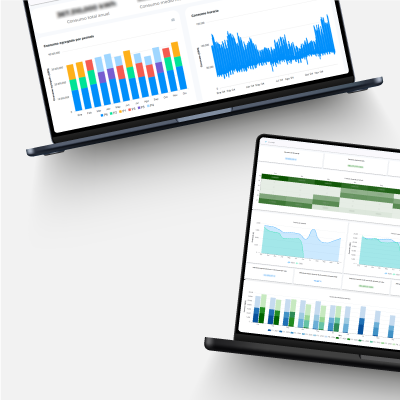
Add BON0 to the equation and you have the specialized solution for your energy efficiency and governance. BON0 is capable of turning clean data into standardized processes, automated validations, contract simulations and dashboards that enable confident decision-making. The combination of both technologies delivers: A digital inventory with metadata and version management. Data quality control with gap detection and self-correction, centralized alarms and an energy intelligence system that calculates key indicators such as kWh per square meter, cost per megawatt-hour, load factor and baselines for measurement and verification, enabling comparison and clustering across different sites.
From a fiscal standpoint, the platform automates invoice verification vis-a-vis contracts, proposes power adjustments, compares purchasing models—pass-through, partial hedging, fixed prices, or PPAs—and incorporates time-based hedging strategies to provide stability. It also offers consumption and cost forecasts that gives your Financial and Purchasing Departments greater visibility for budgeting and negotiation.
How Multisite Energy Management Improves Day-to-Day Operations
Operations and Maintenance teams work from a single console that centralizes all alarms. Each alert is received with detailed information on its location, history, criticality level and guidance for initial intervention. The organization can track key metrics, such as, mean time to repair time and mean time between failures. Moreover, it can generate reliability rankings for different types of equipment—for example, refrigeration units, air handling units, chillers or boilers. Performance deviations, such as a drop in COP under the same conditions, are detected early and preventive actions are triggered. Energy and Sustainability departments use reference curves to quantify real savings and support compliance with standards such as ISO 50001. When deviations occur, contextual factors—such as schedules, occupancy, outdoor temperature, dew point, or possible sensor faults—are analyzed. Sites are also grouped by typology and region to prioritize measures with the greatest impact.
Financial and Purchasing Departments can automate the review of prices, taxes and fixed or variable charges; optimize contracted power and reactive energy; and evaluate different contracting scenarios through transparent simulations. Management has access to a unified corporate dashboard that allows comparison of results across countries and formats, and helps prioritize investments based on return and net present value (NPV), thereby reducing uncertainty.
Multisite Energy Optimization Scenarios
Hotels
Adjusting supply setpoints based on outdoor temperature and occupancy reduces consumption and stabilizes comfort. Integrating booking engines helps fine-tune ventilation and HVAC, avoiding over-conditioning during off-peak hours.
Shopping Centers
Coordinating HVAC, lighting and ventilation using activity data smooths peaks and improves the visitor experience. Submetering facilitates re-billing and automatic invoice validation reduces the administrative effort involved.
Hospitals
Prioritizing critical areas (operating rooms, ICUs) structures alarm response. Air quality is monitored and microgrid simulation strengthens operational continuity.
Distribution and Retail
Coordinating refrigeration and HVAC, managing electric vehicle charging and optimizing benchmarking by format and region enables more informed investments and more precise operations without losing brand identity.
Measurable Impact of Effective Energy Management
- Estimated savings: Between 10% and 30% in energy costs in the first year.
- Up to 40% reduction in invoice validation times and alarm management.
- Regulatory compliance and readiness for decarbonization and Industry 4.0.
Methodology for Implementing Effective Multisite Energy Management
A pilot involving several representative sites builds the digital inventory, validates data quality and defines reusable KPIs and rules. Automated invoice validation, power optimization and benchmarking is achieved within weeks, leaving the infrastructure ready to scale and apply AI tools with tangible returns.
Conclusión: la gestión energética como clave estratégica
Inaction has a direct effect on the bottom line: Higher energy consumption, the use of more spare parts, more failures and inefficient management is the result of not addressing the problem. Automated energy management transforms a mosaic of systems and habits into a modern operating system. Efficiency is ensured, as is control and preparedness for the challenges that the next decade of innovation and digitalization will have to offer.